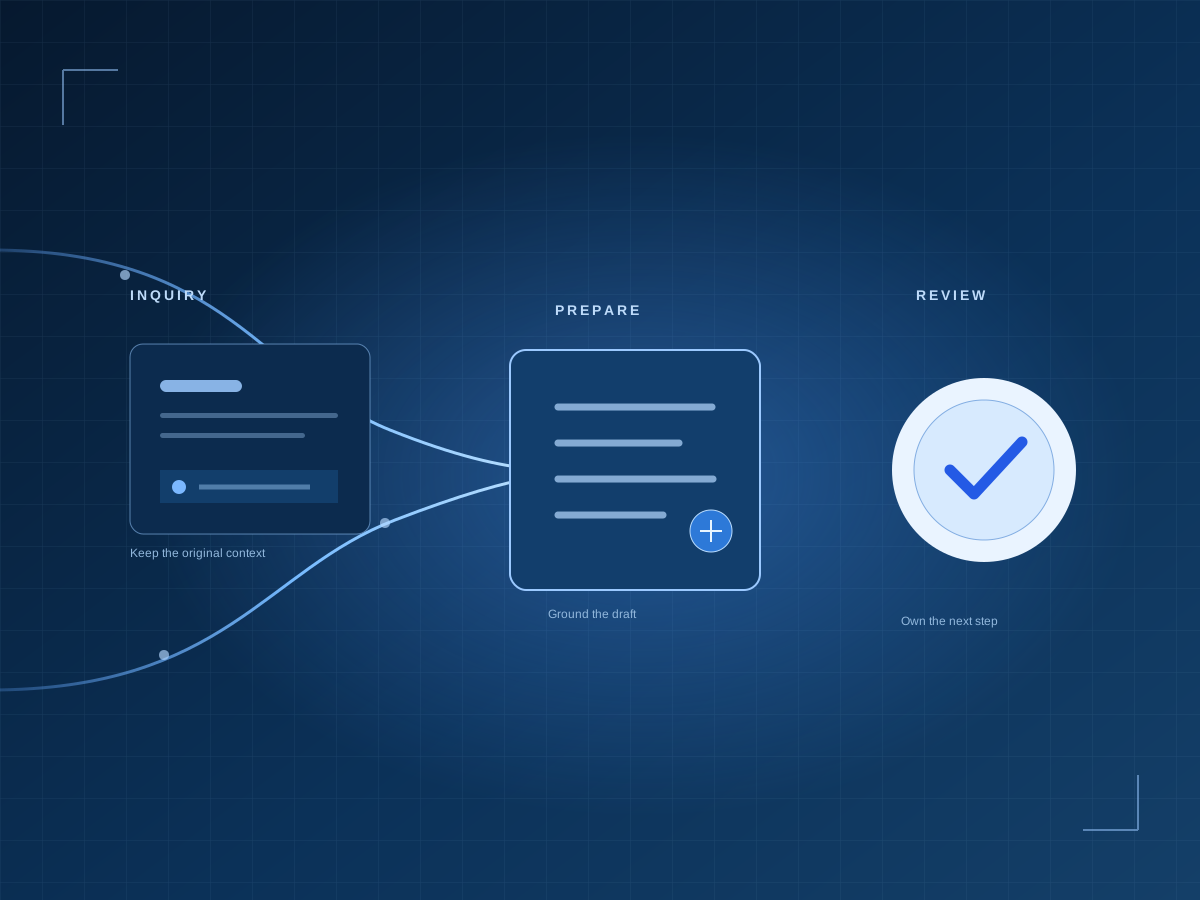
A new lead might arrive through a web form, a shared inbox, or a referral. Then someone needs to understand the request, decide who owns it, prepare a reply, and record what happens next. The slow part is often the handoff between those steps.
An AI-assisted workflow can help prepare information and drafts, while a person stays responsible for the relationship and the final decision. Here is a practical way to design one.
Start with the handoff, not the message
Before drafting anything, map what happens when an inquiry arrives. Where does it enter? Who sees it? What information is usually missing? How does the team decide who should respond? A fast draft cannot fix a lead that has no owner.
Define a small set of states that everyone understands: new, assigned, waiting for information, responded, and closed may be enough. The exact labels matter less than the rule that every open inquiry has an owner and a next action.
1. Capture the original request
Keep the source message intact. Extract useful fields such as name, company, contact channel, stated need, and timing, but make it easy for the reviewer to see the original words. If a field is unknown, leave it unknown; do not let a model guess a budget, intent, or urgency.
Only give the workflow access to information it needs. Sensitive data or private records deserve an explicit access decision before they become part of a prompt or a routing rule.
2. Route by rules the team can explain
Use clear criteria for ownership: region, product area, existing account owner, availability, or a shared queue. AI can help identify the topic of a request, but the routing rule should be visible and reviewable. When information is missing or the request crosses categories, send it to a person rather than forcing a confident classification.
Example: A form asks about automating weekly sales reports. The system tags “reporting,” records the source, proposes the agreed owner, and flags any missing context. A team member confirms the assignment before outreach.
3. Draft from known facts
A good first reply should acknowledge the person’s actual question, state a useful next step, and avoid unsupported promises. Ground the draft in the incoming request and approved company information. Make the source material available to the reviewer so they can catch a wrong assumption quickly.
Use a short, consistent template for the first pilot. Ask the model to mark uncertain details for review rather than filling them in. Avoid invented case studies, delivery dates, prices, or capabilities.
4. Put a human at the send checkpoint
For a first version, have a person approve or edit outbound messages. They can check tone, context, accuracy, and whether a different next step is appropriate. Track edits and exceptions so the workflow improves from real examples.
The NIST AI Risk Management Framework Playbook recommends documenting human oversight and measuring output performance in context. That is useful even for a small pilot: it turns “the drafts look fine” into something the team can actually review.
5. Close the loop in the system of record
Once the response is approved, record who sent it, when, and what should happen next. If the prospect replies, return the conversation to the assigned owner. If no one responds internally within an agreed window, alert the team. Those operational details are often where the value of the workflow appears.
Measure quality as well as speed
Pick a small pilot sample and compare it with the current process. Useful measures include time to assignment, time to first meaningful reply, percentage of inquiries with an owner, reviewer edit rate, and missed follow-ups. Review a sample of messages for relevance and accuracy. A faster message that creates confusion is not a better result.
If the workflow sends promotional email, review applicable requirements before automating sends. In the U.S., the FTC’s CAN-SPAM guidance explains rules for commercial messages, including accurate headers and subject lines and an opt-out mechanism. Requirements depend on the message and jurisdiction, so have the right person review your sending policy.
Keep the first version contained
Choose one intake channel, one team, and one type of inquiry. Prepare the assignment and draft; keep approval manual. Once the team trusts the information flow and understands the exceptions, decide whether to expand it.
If you are still choosing a starting point, read our six-question guide to choosing a first AI workflow. It helps test whether a process has the repetition, inputs, and review path needed for a useful pilot.
Want to map your lead handoff?
Tell us where inquiries arrive and where the next step gets stuck. We can talk through a focused starting point.
Talk through a process ↗